Real Estate Investment Strategy from a Real Estate Broker
Transcript
Tap a timestamp to watch from there
So, a few weeks ago, I made a post on Facebook about my wife and I buying a couple of rental properties. It got a bunch of traction, got a lot of interest, and people started asking me to share. And so, I've written a couple of blog posts, which you can find at chance brown.com, on our philosophy for investing in real estate. Now, I will tell you this is my plan. If you don't like my plan, that's fine. There are about a billion different variables to how anybody invests in real estate, but this is kind of what we want to do based on our goals. In a nutshell, what I am trying to do is create enough cash flow for me to live comfortably in retirement from owned real estate assets. And what I mean by that is there's no debt service. I'm not paying a mortgage. I own enough of these assets that it spits off X amount of dollars every single month that I can live whatever lifestyle I want to live in real estate. A few things that I know. Number one is seek professional help. Have a great lender who knows investment product, who knows your strategy and your goals and what you're wanting to do and have them help you. Number two, know your strengths and weaknesses. Know your risk tolerance.
One of the things about me, I am maybe the most debt averse human being, not named Dave Ramsey, that you've ever met. I have very little personal debt other than my my home. I don't like car payments. I don't have any credit cards. Like, I just don't do debt, period. I understand that that probably limits me in a number of different ways. And I'm okay with debt from the standpoint of purchasing these real estate assets. So, we'll we'll get past that in a minute, but I understand that that can be limiting, but it's how I sleep well at night. Again, this is my plan. You can do whatever you want to in your plan. So, I look for properties that are three-bedroom, two bath, two-car garage, one stories, because if a toilet breaks upstairs, it also breaks everything underneath it. Again, that's my selection criteria. You can make yours whatever else. I like newer construction if I can find it. Preferably in a year that starts with two, not one. There are exceptions to that rule, of course, but that's generally my selection criteria.
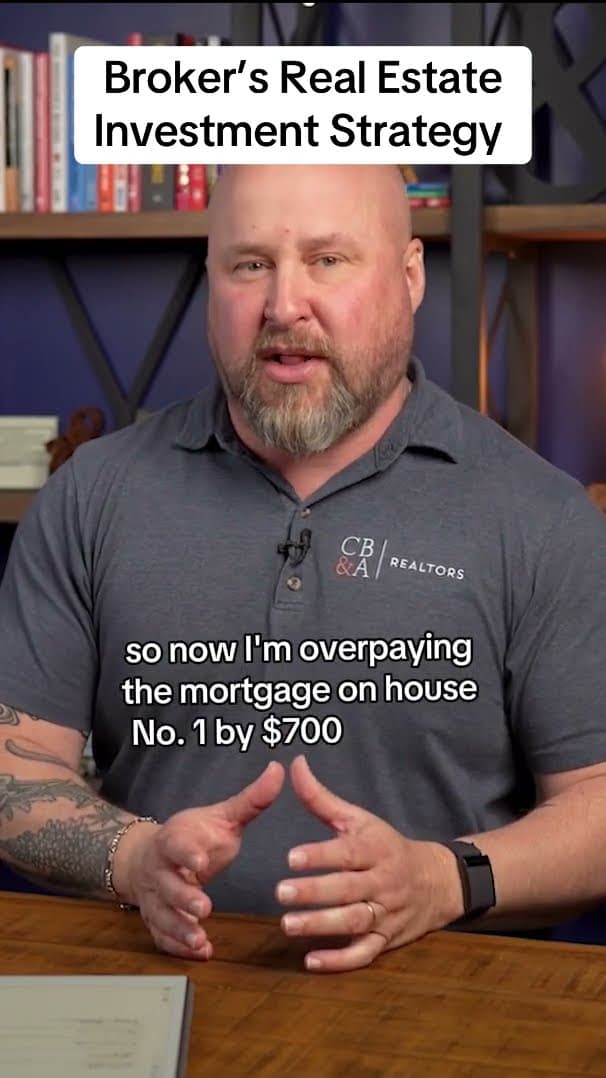
I don't go into places that you have huge amounts of rental competition. My goal is I want to purchase these products and I want to get a tenant in there. And instead of saying, "Okay, my total monthly expenditure is 1,500 bucks and I'm leasing it for $1,850." So there's $350 of cash flow. Instead of me taking that $350 of cash flow, what I do is I pay it back to the principal. And then I go buy the second house. And let's just freeze a math. Say there's $ 350 there, too. I take the $ 350 from house number two and I put it onto house number one. So now I'm overpaying the mortgage on house number one by $700 a month. House number three, now I'm over $1,000 overpaying each month. And so on and so forth until house number one is completely paid off. And let's say now I've keeping taxes and insurance and all of that stuff. Let's say that my total monthly expenditure is 500 instead of 1,500. I'm taking that extra,000 plus the 350 that I already had. So 1350 from house number one, the 350 from all the other houses, and now I'm paying off house 2's note at a clip of maybe $3,000 a month additional principal. So house two gets paid off even faster and so on so forth till you get to a point where either everything's paid off or if you're continuing to buy you don't have to put any of your own money in it anymore because they'll pay off so quickly. And the math that I've done for me and the rate that I want to purchase is somewhere around house 6 or 7, but certainly no more than 10, I get self- sustaining to where if I want to buy another house or two, I can either do a cash out refi of house number one and use those funds to buy house number 10 or 11 or whatever that is, or I could just do a DSCR loan or something like that. And now I've got, you know, $10,000 a month that's being paid towards this house. I can pay the thing off really fast. And so now I own, let's just say that each house was worth $250,000. Now I own $5 million in real estate or whatever that looks like. And I'm spitting off 15, 20, $25,000 a month in rent. That's not a bad way to spend your retirement, especially considering that you're making the initial investment to buy those houses up until the point it gets self-sustaining or million variables. Like I said, maybe you're not. Maybe you're using DSCR and putting minimal amounts down. And so, you know, you might be able to do this with just a few hundred,000 total investment over x number of houses over time and build this asset up by leveraging the people paying your your rent, by leveraging the bank's money, and you can create profound amounts of wealth. If you're listening to this and you're a real estate agent, you have a few legs up here. Number one, because you have access to the MLS and some analysis tools that the general public may not have access to. You have lower acquisition and disposition costs because you can or cannot. the two that I bought last month, I credited my my commission back as money down towards the house. And last but not least, you also have the power of your brokerage.
Keep going
![Why Do People Move? [HINT: It's Not Because of Interest Rates]](/_next/image?url=https%3A%2F%2Fi.ytimg.com%2Fvi%2FxGNqmHlGSzo%2Fmaxresdefault.jpg&w=3840&q=75) Watch4:40
Watch4:40Why Do People Move? [HINT: It's Not Because of Interest Rates]
Nov 10, 2025
 WatchShort
Spend money on things you will actually use for your business
Nov 4, 2025
 WatchShort
There are tons of real estate investment strategies out there btw
May 22, 2025
 Watch3:16
How to Make More Money as an Entrepreneur
Apr 30, 2025
 WatchShort
Don’t just tell clients real estate is a great investment…prove it
Apr 24, 2025

How We Invest in Real Estate, Part 3
Apr 6, 2025